The Problem Is Not Only Evidence Volume
Modern investigations may include body-camera video, interview recordings, photographs, dispatch records, documents, cloud exports, and data acquired from computers or mobile devices. The operational burden comes not only from storing those files, but also from deciding what should be examined first, tracking what has been reviewed, connecting relevant material to a case, and communicating the result to investigators and prosecutors. When those steps are inconsistent, additional evidence can create additional delay rather than clarity.
An NIJ-sponsored 2023 brief offers a useful, carefully bounded view of this pressure. The underlying RTI International research was exploratory: 32 digital-evidence laboratories completed one survey, while 16 law enforcement agencies completed a separate survey and eight more provided some data. The findings should not be read as national prevalence estimates. They do, however, identify practical workflow problems that agencies can compare with their own operations.
Among responding laboratories, 44 percent did not have a digital-evidence triage policy, even though those laboratories received an average of 653 processing requests in 2020. Mobile devices and computers represented about 77 percent of processing requests on average. Half of the responding law enforcement agencies identified laboratory processing time as their largest submission barrier, and about 64 percent reported having a computerized evidence-tracking system capable of tracking digital evidence. The study's limited sample requires caution, but the combination points to an important lesson: collection capacity must be paired with explicit priorities and reliable tracking.
Start With a Written Triage Decision
Triage should answer a concrete question: what evidence needs which level of attention, by whom, and by when? A defensible policy can consider incident severity, investigative urgency, legal deadlines, the likely relevance of a source, available examiner capacity, and the authority under which evidence may be searched. It should also document what was deferred and why. Triage is not a finding that an item is unimportant forever; it is a repeatable way to allocate limited review capacity while preserving the ability to revisit a decision.
The NIJ-sponsored brief recommends clear triage policies for different crime types, precise descriptions of investigative needs when evidence is submitted, review of retention policies, and closer coordination between law enforcement and laboratories. It also suggests regular meetings or a dedicated liaison to standardize submissions and resolve communication gaps. These recommendations are practical because many delays begin before technical analysis: an unclear request can force an examiner to determine the investigator's objective after the evidence is already in the queue.
Preserve First, Organize Second
A source-linked timeline should never replace the original evidence or its formal chain-of-custody record. NIST IR 8387 explains that digital evidence presents preservation issues beyond those associated with traditional physical evidence. The report discusses exact copies, secure hashes or digital signatures, separate and secure storage of hash values, backups, access controls, logging, and documentation of transfers. It recommends hashing evidence as close to collection as possible while also explaining that a failed hash comparison must be investigated in context rather than interpreted mechanically.
That distinction matters. A timeline is an investigative and review aid: it helps authorized users see events in order and return to the source behind an entry. It does not, by itself, authenticate evidence, establish admissibility, or prove that an interpretation is correct. Agencies still need their approved acquisition, preservation, access, retention, disclosure, and courtroom-authentication procedures.
A Practical Pipeline
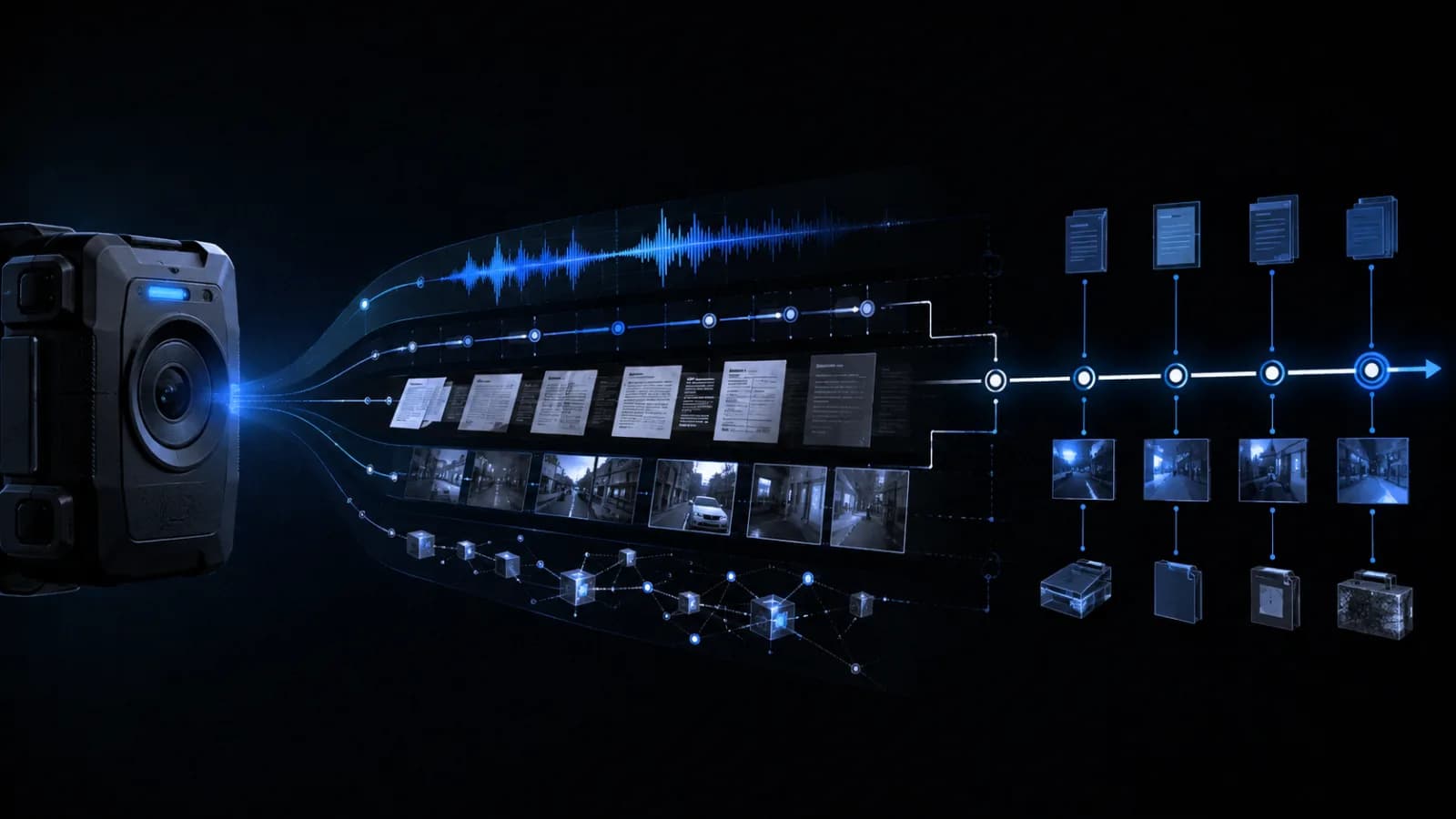
The first stage is intake. Assign evidence to the correct case, record its source and collection context, preserve the original, and apply the agency's integrity controls. The second stage is triage. Record the requested examination, priority, authority, relevant time window, and reviewer. The third stage is normalization and indexing. Create working representations that make authorized review possible without silently modifying the preserved original.
The fourth stage is event extraction. Potentially relevant moments can be organized by date and time, source, people or entities mentioned, location, and review status. Automated assistance may help surface candidate events, but a trained reviewer should confirm what the source actually supports and separate observation from inference. Conflicting timestamps, ambiguous speakers, missing context, and gaps between sources should remain visible rather than being smoothed into a falsely certain narrative.
The fifth stage is the source-linked timeline itself. Each material entry should let a reviewer identify the underlying file or record and, where appropriate, the relevant segment. The sixth stage is handoff. Investigators, supervisors, analysts, prosecutors, and other authorized recipients need a controlled way to understand what has been reviewed, what remains pending, and whether an item is a verified fact, a person's statement, or an investigative hypothesis.
Connect Evidence Management to the Downstream Case
The Bureau of Justice Assistance's FY2025 body-worn camera funding notice is a program document, not a generally applicable regulation. Still, its goals illustrate capabilities public agencies are being encouraged to plan for: secure capture, storage, and retention; integration with case-management systems; streamlined transfer to prosecutors; efficient storage, tagging, and retrieval; and cross-agency workflows involving law enforcement, prosecutors, and courts. Those priorities support a lifecycle view of evidence rather than a collection-only view.
Measure the Queue and the Outcome
A useful backlog metric is more specific than the total number of files. Agencies can track age by priority, time from intake to first triage, time awaiting clarification, percentage of submissions returned for missing information, reviewer workload, unresolved preservation exceptions, and time required to prepare a controlled handoff. They can also audit whether timeline entries return to the expected source and whether access and changes are recorded.
The goal is not to automate conclusions about guilt, credibility, or legal sufficiency. It is to reduce preventable friction between collection and informed human review. A source-linked timeline is valuable when it preserves uncertainty, keeps the original evidence authoritative, and gives each authorized participant a faster path back to the material supporting the case.