AI police report writing from body-camera footage.
Code Four REPORT turns body-worn camera footage, transcripts, dispatch context, officer notes, and agency templates into source-linked, review-ready police report drafts — with the officer responsible for verifying every fact before filing.
NARRATIVE
On the date of this report, I was driving a patrol vehicle when a 20 mph speed limit sign was visible. My in-car radar displayed fluctuating speeds of passing vehicles. I subsequently made a turn and pulled into a gravel driveway behind a dark-colored two-door coupe (OR Plate 08396), which had a red driver's side door (00:24).
I exited my vehicle and approached the driver of the coupe, identifying myself as Officer Light from the Milton-Freewater Police Department (00:31). The driver was a white male with a beard, wearing a plaid shirt and a baseball cap. I informed the driver that he was pulled over for having no front license plate, window tint that was "too dark for the state of Oregon," and expired registration tabs from 2023 (00:39). The driver acknowledged the tabs were expired and stated he was "DoorDashing right now so that I can get the tabs renewed" (00:52). He explained that he had just purchased the vehicle back from a friend approximately two weeks prior.
When I asked for his driver's license, the driver stated he did not have a hard copy on him (01:17). He indicated he possessed a Washington driver's license but mentioned "some legal trouble" and said, "Last I remember, I was suspended in Oregon" (01:53). He provided his name as ZACHARIAH TINDER and his date of birth as March 2, 2002 (01:38, 01:49). I informed ZACHARIAH TINDER that our conversation was being recorded (02:17). ZACHARIAH TINDER confirmed he was at the property of the person for whom he was making a DoorDash delivery. He also stated he did not have insurance on the vehicle and had only been driving it "today" (02:37).
I returned to my patrol car to run ZACHARIAH TINDER's information (02:58). I radioed dispatch, providing ZACHARIAH TINDER's name and date of birth, and stated, "He should be suspended" (03:47). While I was waiting, a woman approached ZACHARIAH TINDER's car to retrieve her delivery, and I told her she could get her items (04:53). Dispatch subsequently confirmed that ZACHARIAH TINDER had no warrants but was suspended for Driving While Suspended (DWS) in Oregon and was also suspended in Washington (05:58). I indicated that a citation would be issued and exited my vehicle.
I re-contacted ZACHARIAH TINDER and stated, "Why'd you lie to me, man? You were pulled over two weeks ago in Washington and they even told you you you were suspended" (06:27). ZACHARIAH TINDER claimed he had gone to court and was told he was eligible to reinstate his license. I countered that a live DMV check showed ZACHARIAH TINDER was currently suspended in both states (06:41). I informed ZACHARIAH TINDER that because his license was suspended, the vehicle would be impounded (07:06).
I spoke with a woman in a black SUV who was attempting to leave the property. She confirmed it was her house and stated ZACHARIAH TINDER's car was in her husband's parking spot and needed to be moved (07:44). I informed her that I would have the vehicle towed. I then took the keys from ZACHARIAH TINDER (08:15).
Back in my patrol car, I completed paperwork on my computer and radioed dispatch to request a tow for the vehicle, citing DWS and no insurance (10:46). I clarified the location as the driveway of 1310 South Main. Dispatch advised that Chamber's Towing was en route with an approximate 20-minute ETA (12:26).
I printed a citation and an impound form and provided them to ZACHARIAH TINDER (13:09). I explained the citations were for driving uninsured, driving while suspended, and failure to register a vehicle. I pointed out that the court date was April 9, 2026, at the Milton-Freewater court (14:36). I also gave ZACHARIAH TINDER a verbal warning for the window tint, stating it was far below the legal 35% limit (13:36). I gave ZACHARIAH TINDER the impound form, explaining that he would need proof of ownership, insurance, and a valid driver to retrieve the vehicle from the tow yard after paying fees at the police department (16:40). I told ZACHARIAH TINDER he had approximately 20 minutes to gather his belongings from the car and arrange for a ride
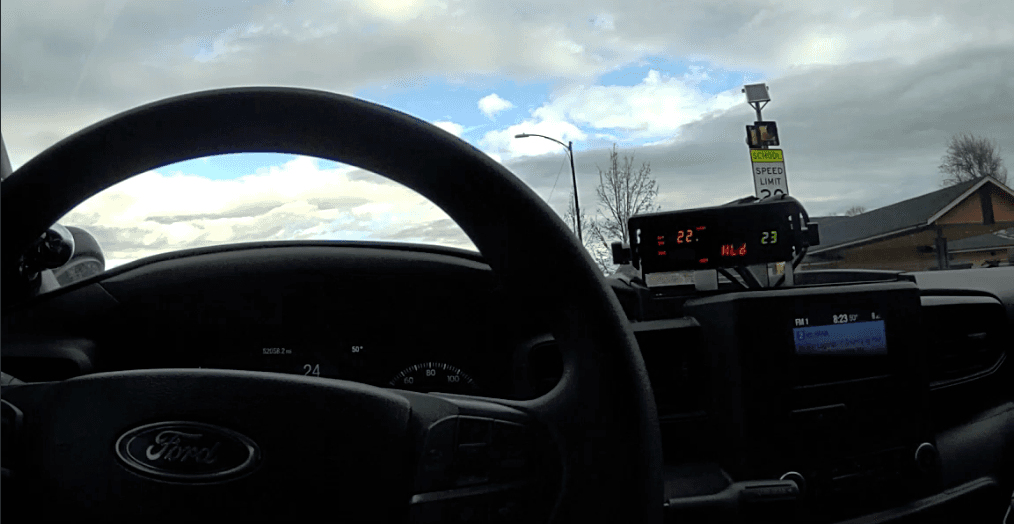

did the subject ever look off to the side and seem uncomfortable when I was asking him questions?
Yes, the subject displayed several signs of discomfort, including frequently looking down and to the side, avoiding eye contact, and rubbing his chin, particularly when you began questioning him about his driver's license (01:23, 01:31, 01:38, 01:53).
Built for the evidence officers already collect on every call.
Report writing slows officers down because the details are scattered across video, audio, dispatch, and notes. Code Four REPORT pulls those sources together into a single, source-linked first draft.
Body-worn camera footage
Turn body-camera video, speaker turns, timestamps, and visual context into a structured first-draft narrative officers can review.
Transcripts and audio
Use recorded statements, field audio, and transcript turns to capture what was said without re-listening to the entire recording.
Dispatch and CAD context
Bring call details, incident type, timestamps, units, and supplemental context into the same report-writing workflow.
Officer notes and observations
Combine short field notes, voice memos, and observations with primary evidence so nothing important gets left out of the draft.
Photos and supplemental evidence
Attach scene photos, documents, and supplemental files alongside the narrative so reviewers have full context in one place.
Agency templates and rules
Apply department terminology, formatting, and local report rules so first drafts match how your agency already writes.
From footage to filed report.
The goal is not to remove the officer. It is to remove the blank page — a faster first draft, grounded in source evidence, that the officer reviews and approves.
Upload the evidence
Officers add body-camera footage, transcripts, dispatch context, photos, and notes from the call into a single report workspace.
Generate a source-linked draft
Code Four Report writes a first-draft narrative with facts tied back to the original video, transcript, and timestamp.
Review and verify
Officers check each fact against the linked source moment, edit the language, and stay responsible for accuracy before filing.
Approve and hand off
Final reports move into supervisor review and detective follow-up with evidence context preserved for investigations.
AI police report writing FAQ.
What is AI police report writing software?
AI police report writing software helps officers create a first draft of an incident report from body-worn camera footage, transcripts, dispatch context, notes, and agency templates. The officer remains responsible for review and final submission.
Does Code Four replace officer report writing?
No. Code Four Report is a drafting and review tool. Officers verify the facts, edit the narrative, check source evidence, and approve the final report before it enters the agency workflow.
How does source-linked review work?
Report drafts keep narrative facts tied to the original video, transcript, timestamp, or evidence moment so officers and supervisors can verify language back to its source before filing.
Can Code Four work with our body camera provider?
Yes. Code Four is designed to work across body-worn camera systems and can ingest video, transcripts, dispatch context, officer notes, photos, and supplemental evidence.
Does it match how our agency writes reports?
Code Four Report applies agency templates, terminology, and local report rules so first drafts follow the formatting and style your department already uses.
How does report writing connect to investigations?
Reports written in Code Four keep source-linked context that can move into Code Four INSIGHTS, so patrol narratives and evidence support investigative follow-up.
Connect report writing to the full agency workflow.
Agencies evaluating AI report writing often need to connect the report product, investigations, case studies, and integration requirements before choosing a platform.
Code Four REPORT
Explore the product page for AI police report writing, body-camera drafting, source-linked review, and agency templates.
AI investigation software for police
See how source-linked report narratives move into Code Four INSIGHTS for evidence processing and case intelligence.
Police AI case studies
Review agency case studies and rollout profiles for report writing, body-camera review, investigations, and digital evidence workflows.
Law enforcement integrations
Review how Code Four fits alongside body-camera systems, RMS, CAD, and existing department workflows.
Give officers their time back.
Code Four REPORT keeps officers in control of every report while removing the blank-page burden — and the source-linked context flows into Code Four INSIGHTS for investigations.